
Robotics and Embodied AI Companies in the UK: The 2026 Landscape

 Xium Labs AI Team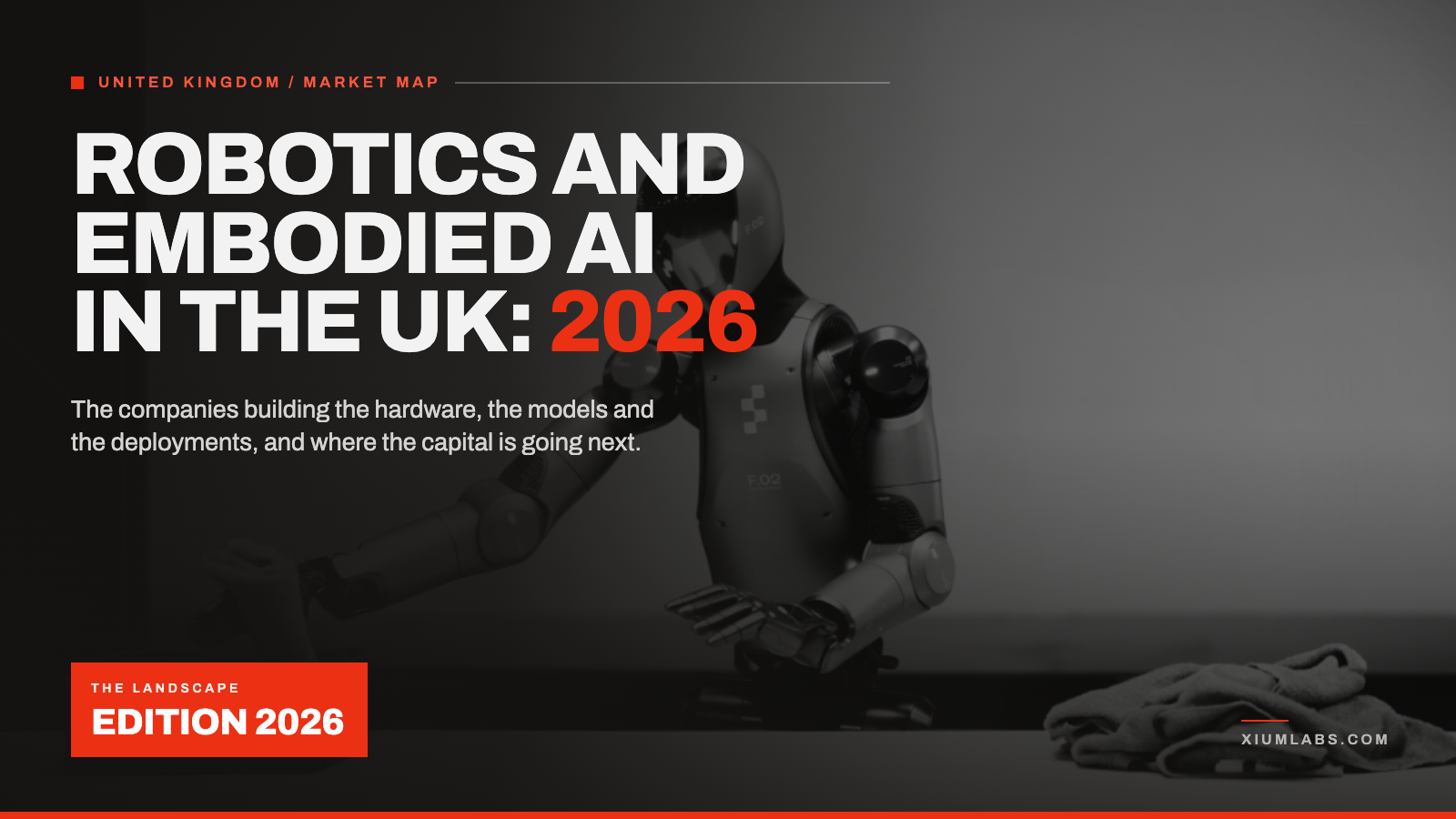
- Embodied AI on the road: Wayve and Oxa
- Logistics and warehouses: Dexory, London
- Healthcare: CMR Surgical, Cambridge
- The manufacturing backbone: Tharsus and the North East
- The research engines: Manchester and Newcastle
- The layer nobody maps: security for embodied AI
- What this landscape means if you are buying
- Which UK companies make humanoid robots?
- What is the biggest robotics company in the UK?
- Is London good for robotics companies?
- What is embodied AI?
- Who tests the security of robots and AI systems in the UK?
The UK now has a genuine embodied AI industry rather than a collection of research projects. London produced Britain's first humanoid robotics unicorn in 2026, warehouse and surgical robots built here are deployed across dozens of countries, and the manufacturing base stretches from Cambridge to the North East. This guide maps the companies that matter, what each actually does, and where the gaps are, including the one almost nobody is covering: who secures all of this.
Ask most people to name a robotics nation and they will say Japan, the United States or China. The UK rarely makes the first breath, which says more about British understatement than the facts. In 2026, machines designed and built in Britain are performing surgery in more than twenty countries, scanning warehouses across Europe, learning to drive on public roads, and, as of this year, being ordered by the thousand as humanoid workers. Here is the landscape as it actually stands, from someone who works inside it.
The humanoid frontier: Humanoid, London
The story of the year. Humanoid, founded in London in 2024 by Artem Sokolov, closed a 152 million dollar Series A in July 2026 at a 1.35 billion dollar valuation, becoming Britain's first dedicated humanoid robotics unicorn. Bosch is signed as its contract manufacturer, Schaeffler has placed a commercial order reported at 1,000 units, and beta deployments across logistics, manufacturing and retail are planned before the end of 2026. Whatever you think of humanoid timelines, the capital, the manufacturing partner and the order book are real, and they are British. We covered the wider deployment wave, and its risks, in our article on humanoid robots in the UK and Europe.
Embodied AI on the road: Wayve and Oxa
Two companies carry the UK's claim in autonomous driving, and both are really embodied AI companies wearing automotive clothing. London's Wayve pioneered the end-to-end learned approach, training a single AI model to drive rather than hand-coding rules, and drew one of the largest investment rounds in UK technology history to do it, with SoftBank, NVIDIA and Microsoft among its backers. Oxford's Oxa builds the software layer for autonomous vehicles and industrial mobility, selling autonomy as a capability that other operators deploy in their own fleets. Between them they represent the two viable business models for physical AI: build the brain, or license it.
Logistics and warehouses: Dexory, London
If you want to see British robots earning revenue today, look in a warehouse. Dexory's autonomous robots scan and map warehouse environments in real time, feeding stock and operational data into a digital twin of the facility, and the company has raised over 167 million pounds, including a 123.8 million pound Series C led by Atomico in October 2025. It is among the fastest-scaling robotics businesses in Europe, and it is headquartered in London. Warehouse automation rarely makes headlines, which is exactly why it makes money.
Healthcare: CMR Surgical, Cambridge
The elder statesman of this list. Cambridge-based CMR Surgical builds Versius, a modular robot-assisted surgery system designed as a portable alternative to fixed-tower surgical robots, now used in hospitals across more than twenty markets. CMR reached unicorn status back in 2019 and has manufactured at scale in Cambridgeshire since, a reminder that the UK can take a robot from research bench to regulated clinical product and global export, because it already has.
The manufacturing backbone: Tharsus and the North East
Not every important robotics company sells robots under its own name. Tharsus, based in Blyth in Northumberland, designs and manufactures complex robotic machines for other businesses, and sits at the centre of a North East advanced manufacturing economy worth around 8.4 billion pounds across nearly 4,000 firms, anchored by Nissan's Sunderland plant. When the humanoid wave needs somewhere in Britain to actually build, integrate and maintain machines at industrial scale, this is where the capability lives. It is also, alongside Teesside's process industries, where we expect early industrial deployments to concentrate, for reasons we set out in our regional analysis.
The research engines: Manchester and Newcastle
The pipeline behind the companies runs through the universities. The University of Manchester's Centre for Robotics and AI is among the UK's leading robotics research groups, spanning nuclear decommissioning, flexible manufacturing and healthcare robotics, while Newcastle University's advanced manufacturing work and the region's Centre of Excellence for Sustainable Advanced Manufacturing connect research directly to the factories that will absorb it. Talent from these clusters staffs most of the companies above.
The layer nobody maps: security for embodied AI
Every company on this list ships the same three things whether they advertise them or not: an AI stack, a fleet of networked machines, and a cloud platform controlling both. That combination is an attack surface, and from 20 January 2027 it is also a regulated one, when the EU Machinery Regulation makes a cybersecurity risk assessment part of the CE mark itself. This is the layer of the landscape we occupy. Xium Labs, operating from London and Teesside, builds AI products and intelligent automation, and our offensive security practice tests the systems embodied AI depends on, from the models themselves to the APIs and networks beneath them. Embodied AI is a space we are actively building in ourselves, and as this market grows, the companies that treat security as part of the product rather than an afterthought will be the ones enterprise buyers trust with their floors, their data and their people.
What this landscape means if you are buying
Three practical readings. First, the UK supply chain is more complete than its reputation: you can source the machine, the integration, the AI and the security assessment domestically. Second, the money has arrived ahead of the standards, so due diligence falls on the buyer; ask any vendor on this list, or off it, for their conformity file and their security testing evidence before signature, using the vendor questions we published for humanoid procurement as a starting point. Third, regional strategy matters: London is where deals are signed, but deployment capability concentrates in Cambridge, the North West and the North East, and pricing and talent follow that geography.
Frequently asked questions
Which UK companies make humanoid robots?
Humanoid, headquartered in London, is the UK's dedicated humanoid robotics company, with a wheeled and a bipedal platform and commercial deployments beginning in 2026. Several international humanoid makers also sell or rent into the UK, including through Robot-as-a-Service models.
What is the biggest robotics company in the UK?
By valuation, CMR Surgical and Humanoid are both unicorns, and Wayve's funding places it among the most valuable AI companies in Europe. By deployed commercial fleets, Dexory in logistics and CMR in surgery lead the field.
Is London good for robotics companies?
London concentrates the capital, the AI talent and the enterprise buyers, which is why Humanoid, Wayve and Dexory are headquartered there. Manufacturing and integration capability sits mostly outside the capital, in Cambridge, the North West and the North East.
What is embodied AI?
AI that acts in the physical world through a machine: a robot, a vehicle, a drone. It combines learned models with sensors and actuators, which is what separates it from purely digital AI, and what makes its security and safety inseparable.
Who tests the security of robots and AI systems in the UK?
Specialist offensive security firms assess the AI models, companion applications, APIs and networks that robotic systems depend on. Xium Labs provides this from London and Teesside, and from January 2027 such assessments become part of EU market access for machinery under the Machinery Regulation.
Keep reading
All articles → Applied AI
Humanoid Robots and Embodied AI: What They Actually Mean for Business
Embodied AI is moving from demo to deployment. We cut through the hype: where humanoid robots work today, what still holds them back, and why the real value sits in the intelligence layer.
Read more→ Cyber Security
Mobile App Penetration Testing Methodology: How We Test, Step by Step
How a proper mobile app pentest works, phase by phase: OWASP MASVS scoping, static and dynamic analysis, API and business logic testing, reporting and retest.
Read more→ Product Engineering
The EU Machinery Regulation 2027: What Robot Makers and Deployers Must Do Before 20 January, 2027.
EU Machinery Regulation 2027: Robots, CE Marking & Cybersecurity
Read more→