
Mobile App Penetration Testing Methodology: How We Test, Step by Step

 Xium Labs Cyber Team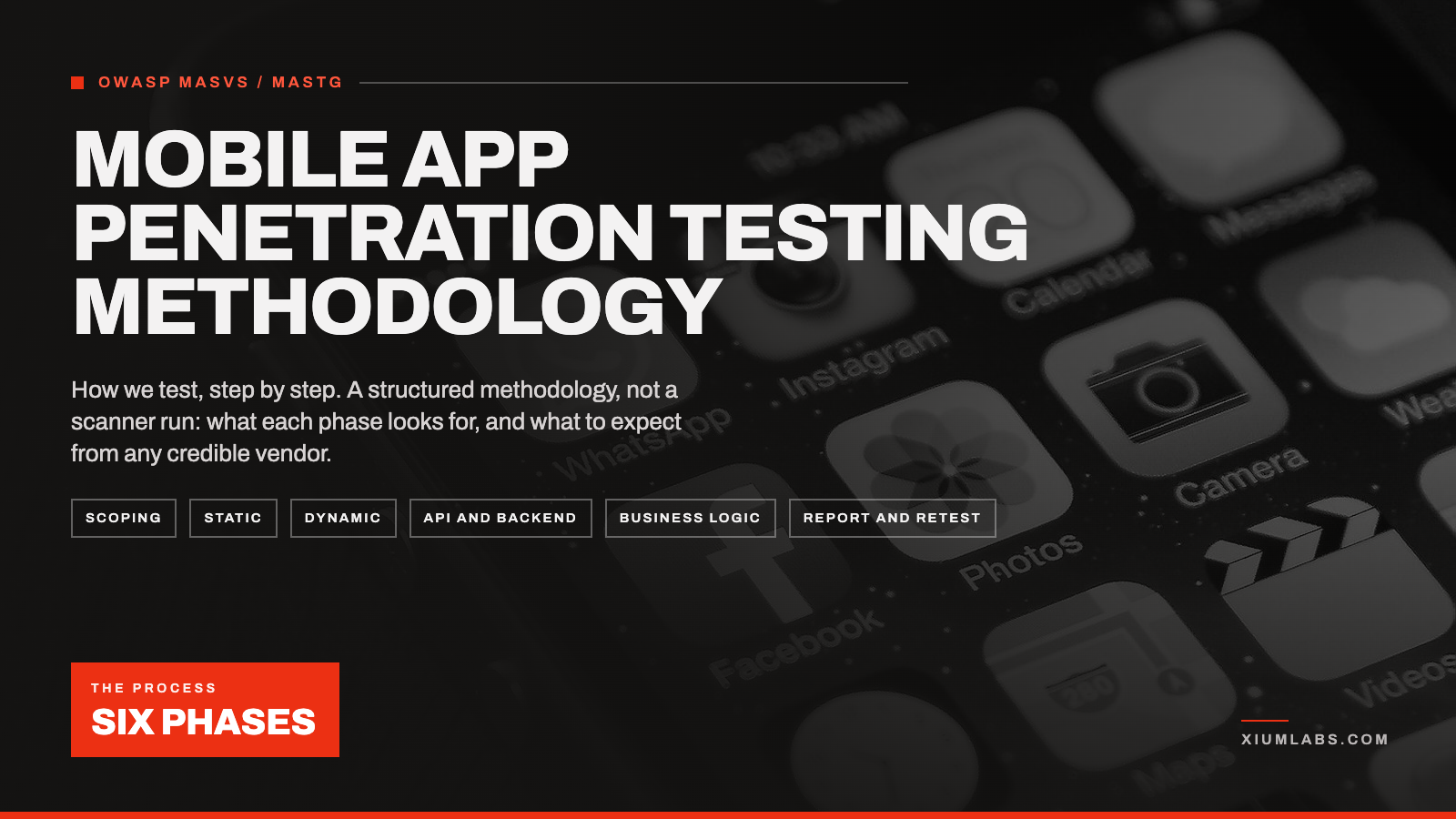
- The standard behind the method: OWASP MASVS and MASTG
- Phase 1: Scoping and threat modelling
- Phase 2: Static analysis
- Phase 3: Dynamic analysis
- Phase 4: API and backend testing
- Phase 5: Business logic testing
- Phase 6: Reporting and retest
- What this methodology means for you as a buyer
- Work with us
- Frequently asked questions
- What methodology should a mobile app penetration test follow?
- How is a mobile pentest different from a vulnerability scan?
- Do you need the app's source code for a penetration test?
- How long does each phase take?
- What should the report contain?
- How quickly can Xium Labs quote and start?
A proper mobile app penetration test follows a structured methodology, not a scanner run. Ours is built on the OWASP Mobile Application Security Verification Standard (MASVS) and its testing guide (MASTG), and moves through six phases: scoping, static analysis, dynamic analysis, API and backend testing, business logic testing, and reporting with retest. This article walks through each phase, what it looks for, and what you should expect to see in any credible vendor's process. If a provider cannot describe their methodology at this level, you are probably buying a scan with a report template around it.
When companies compare penetration testing quotes, they compare prices and timelines, because those are the numbers on the page. The thing that actually determines whether the test protects you is the methodology behind it, and that is usually the part nobody asks about. Before founding Xium Labs I spent years delivering penetration tests professionally, and I have read too many reports from other providers that were scanner output wearing a suit. So here is exactly how a mobile application penetration test should work, phase by phase, so you can hold any vendor, including us, to it.
We covered what a mobile app pentest costs in the UK in an earlier article. This one covers what those days of testing actually contain.
The standard behind the method: OWASP MASVS and MASTG
Credible mobile testing is anchored to the OWASP Mobile Application Security Verification Standard, which defines what a secure mobile app looks like, and the Mobile Application Security Testing Guide, which defines how to verify it. MASVS sets out control groups covering storage, cryptography, authentication, network communication, platform interaction, code quality and resilience, and it defines verification levels: L1 as the baseline for most apps, L2 for apps handling sensitive data such as fintech and health, and a resilience layer for apps that need to withstand reverse engineering and tampering. Agreeing the target level at the start is not paperwork; it decides how deep the test goes and what the report can honestly claim. Our mobile application penetration testing service tests to these standards on every engagement.
Phase 1: Scoping and threat modelling
Before anything is attacked, we establish what exists and what matters. That means the platforms in scope (iOS, Android or both), the app's user roles, the backend APIs it consumes, the data it stores and transmits, and the realistic threat actors: an opportunistic attacker with a stolen device, a malicious user probing the API, an attacker on the same network. From this we agree the MASVS level, the test environment (ideally a staging build with production-equivalent controls), and the rules of engagement. A test scoped in an hour on a sales call is a test scoped wrong.
Phase 2: Static analysis
We take the application apart before we run it. The binary is decompiled and examined for hardcoded secrets and API keys, weak or misused cryptography, insecure local storage of credentials and personal data, exported components and deep links that expose functionality, and the configuration of platform protections. Automated tooling has a place here as a first pass, but the findings that matter come from a human reading how the app actually handles data, because a scanner can flag an encryption function and cannot tell you the key sits three lines above it.
Phase 3: Dynamic analysis
Then we run the app on real and instrumented devices, jailbroken and rooted where the threat model calls for it, and watch what it does rather than what its code claims. This phase covers runtime data exposure in memory, logs, screenshots and keyboards, certificate pinning and how the app responds to man-in-the-middle interception, session handling across backgrounding and reinstalls, and whether root and jailbreak detection or anti-tampering controls hold up under instrumentation. Dynamic work is where the gap between the developer's intent and the device's reality shows itself.
Phase 4: API and backend testing
Most severe mobile findings are not in the mobile binary at all. They live in the backend: broken object-level authorisation that lets one user pull another's records, authentication and token weaknesses, mass assignment, rate limiting that exists in the app but not the API, and endpoints the app no longer uses but the server still answers. We intercept and replay every call the app makes and then test the API as an attacker would, directly, without the app's polite behaviour in the way. This is why a mobile test that excludes the APIs behind the app is scoped wrong, whatever it costs. If you have a quote in hand that does not mention API testing, send it to us and we will tell you, frankly and without obligation, what it covers and what it misses.
Phase 5: Business logic testing
The phase no tool can do. Business logic testing asks whether the app's rules can be abused while working exactly as built: can a discount be applied twice, a payment amount be tampered with between screens, a verification step be skipped by calling the later endpoint first, a role boundary be crossed by replaying another role's request. These findings tend to be the most damaging in production precisely because every component involved is functioning correctly. They are also the reason testing is priced in human days rather than scanner minutes.
Phase 6: Reporting and retest
The output is a report your engineers can act on and your auditors can rely on: each finding with a CVSS severity, clear reproduction steps, evidence, and remediation guidance written for the people who will fix it, plus an executive summary in plain language for the people who will fund the fixing. We walk the findings through with your team, and once fixes land, we retest and issue an updated report confirming what closed. A test without a retest leaves you holding a list of problems and no evidence you solved them, which is half a product.
What this methodology means for you as a buyer
Three practical uses for all of the above. First, it is a comparison instrument: ask any prospective vendor to describe their process phase by phase, and listen for whether APIs and business logic appear, because their absence is the signature of a scan sold as a test. Second, it explains scoping questions that otherwise feel intrusive; when we ask about roles and endpoints before quoting, this is why. Third, it maps directly onto compliance: ISO 27001, SOC 2 and PCI DSS assessors expect testing evidence with exactly this structure, and from 2027 the EU's machinery and product security rules push the same discipline into connected and robotic systems.
Work with us
Every Xium Labs engagement runs the methodology above and includes the backend API, a CVSS-rated report with reproduction steps and remediation guidance, a debrief with your engineers, and a retest of fixed findings. Scoping is straightforward: tell us the platforms, the number of user roles and roughly how many API endpoints the app uses, and we will return a fixed price within one working day. No discovery-call theatre, and a sample report is available on request so you can judge the quality of the output before you spend anything. Get your fixed quote here.
If you build apps for other people, we should also talk. Development agencies, product studios and software consultancies partner with us to test the applications they ship, so their clients get independent security assurance and they get a security capability without hiring for it. The same applies to compliance consultants whose clients need testing evidence for ISO 27001, SOC 2 or PCI DSS. Introduce yourself and we will set up a simple way of working together.
Frequently asked questions
What methodology should a mobile app penetration test follow?
The industry standard is OWASP MASVS with the MASTG testing guide, agreed at a verification level matching the app's risk: L1 as a baseline, L2 for sensitive data, with resilience testing where reverse engineering matters. Any credible vendor should name their methodology unprompted.
How is a mobile pentest different from a vulnerability scan?
A scan runs automated checks for known issues and finishes in hours. A penetration test is a human working through static, dynamic, API and business logic phases over several days, finding the authorisation and logic flaws scanners structurally cannot see. Compliance frameworks and enterprise clients almost always require the test.
Do you need the app's source code for a penetration test?
No. Most mobile tests are performed against the compiled app, as an attacker would encounter it. Source access enables a deeper hybrid approach and can make some findings faster to confirm, but its absence does not prevent a thorough test.
How long does each phase take?
For a typical single-platform app, scoping takes up to a day, static and dynamic analysis two to three days combined, API and business logic testing one to three days depending on the backend's size, and reporting one to two days. Complex apps with multiple roles extend the middle phases.
What should the report contain?
CVSS-rated findings with reproduction steps and evidence, remediation guidance for engineers, an executive summary for decision makers, and a retest confirming fixes. If a sample report is not available before you sign, ask why.
How quickly can Xium Labs quote and start?
We return a fixed quote within one working day of receiving three details: platforms, user roles and approximate API endpoint count. Testing typically begins within one to two weeks of sign-off, depending on scheduling and environment readiness.
Keep reading
All articles → Cyber Security
How Much Does Mobile App Penetration Testing Cost in the UK? (2026 Pricing Guide)
What does a mobile app pentest cost in the UK? Realistic 2026 price ranges, the factors that move the number, and how to scope a test without overpaying.
Read more→ Cyber Security
Penetration Testing for London Businesses: How Our Team Works
London is a prime target: 43% of UK businesses were breached last year. Here is how our team runs penetration tests for London clients, from scoping to fixes and a free retest.
Read more→ Applied AI
Robotics and Embodied AI Companies in the UK: The 2026 Landscape
The UK robotics and embodied AI companies that matter in 2026 from London's humanoid unicorn to Cambridge, Manchester and the North East, and who secures it all
Read more→